Renovated Right, Sold Wrong: The Parkview Upgrades That Cost Sellers More Than They Earn
There is a particular frustration reserved for sellers who have invested substantially in their homes only to find that buyers are unmoved—or worse, deterred. In Parkview, where renovation activity is widespread and homeowner investment is high, this scenario plays out with uncomfortable regularity. The problem is rarely the quality of the work. The problem is the assumption that personal preference and market value occupy the same territory.
They often do not.
This analysis examines the specific upgrades and design decisions that Parkview's transaction data and buyer feedback have consistently identified as value-neutral at best, and actively counterproductive at worst. The goal is not to discourage investment in homes, but to redirect it toward choices that the market will actually reward.
The Customization Trap
Parkview attracts a buyer pool with strong aesthetic opinions. That is, in many ways, an asset for the community. It also creates a specific risk for sellers who have renovated according to their own tastes without considering how those choices will read to a stranger.
Highly customized spaces—murals, specialty paint treatments, built-in furniture configured for a specific lifestyle, or room conversions that eliminate conventional functionality—require buyers to perform an act of imaginative translation that many are unwilling or unable to do. A home office that has been converted into a dedicated recording studio, complete with acoustic paneling and wiring for professional equipment, does not read as a versatile space. It reads as a project.
Buyers in Parkview's price ranges are not typically looking for projects. They are looking for move-in-ready homes that reflect their own sensibilities. When a property's renovations reflect someone else's highly specific vision, even excellent craftsmanship cannot fully overcome the psychological resistance that customization creates.
The Kitchen Overcorrection
Kitchen renovations remain one of the most common investments Parkview sellers make before listing, and they remain one of the most frequently miscalibrated. The issue is not that kitchen upgrades fail to add value—they often do. The issue is the degree to which sellers over-invest relative to the neighborhood's price ceiling.
In portions of Parkview where median sale prices sit in a defined range, a kitchen renovation that would be appropriate for a home priced significantly above that range does not automatically push the property into a higher tier. It simply raises the seller's cost basis without a corresponding market return. Buyers in that price range have expectations calibrated to the neighborhood, and a $90,000 chef's kitchen in a home that comps at $450,000 does not produce a $540,000 sale. It produces a $460,000 sale with $90,000 in sunk costs.
Feedback from buyers who toured and declined to offer on over-renovated Parkview kitchens frequently cites a related concern: the sense that the rest of the home cannot live up to the kitchen. When one space has been upgraded so dramatically that it creates a mismatch with surrounding rooms, buyers begin mentally cataloguing everything that falls short—a process that rarely ends favorably for the seller.
Luxury Bathrooms in Non-Luxury Contexts
The same logic applies to bathroom renovations, perhaps even more acutely. Walk-in steam showers, radiant heated floors, and spa-grade fixtures are genuine amenities in the right context. In Parkview homes that do not otherwise support a luxury positioning—whether due to square footage, lot size, or neighborhood price norms—they function more as curiosities than selling points.
Buyers who encounter a $40,000 primary bathroom in a home where the secondary bedrooms have original windows and the basement is unfinished do not feel they are getting a deal. They feel they are being asked to subsidize someone else's indulgence. The imbalance between upgraded and non-upgraded spaces is, in buyer psychology, a form of disclosure—it tells a story about a seller who invested selectively and emotionally rather than strategically.
Niche Design Trends That Have Aged Poorly
Parkview's housing stock includes a meaningful number of homes renovated during periods when specific design trends were at their peak popularity. Several of those trends have not aged gracefully in the eyes of today's buyers.
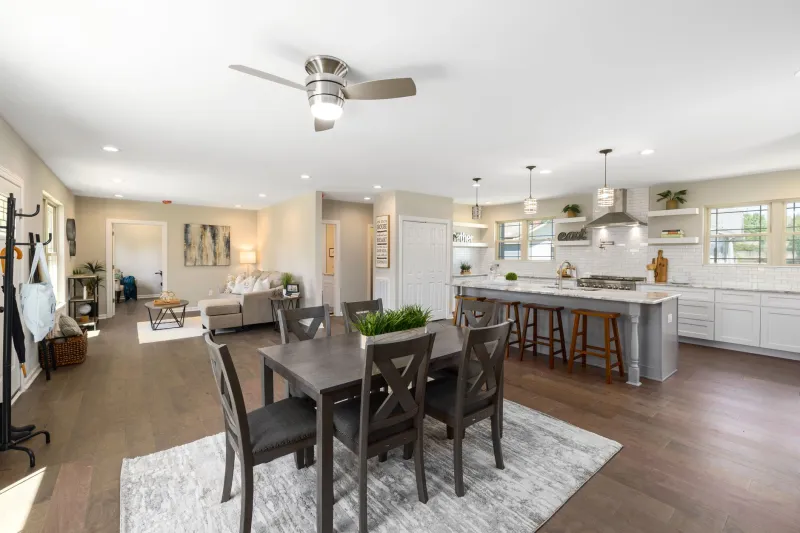
Open-concept layouts, once nearly universally desired, have become more complicated as remote work and multi-generational living arrangements have increased buyer demand for defined, acoustically separated spaces. Sellers who removed walls to create sweeping open floors during an earlier renovation cycle may now find themselves fielding questions about how the home accommodates privacy and noise management.
Gray-toned everything—flooring, cabinetry, countertops, walls—became so dominant in Parkview renovation projects between roughly 2015 and 2021 that it has begun to register as dated rather than contemporary. Buyers who encounter an all-gray interior often perceive it as a home that was renovated once and has not been refreshed since, regardless of when the work was actually completed.
Bold accent walls and statement tile work, particularly in entryways and bathrooms, present a related challenge. When executed with restraint, they can be distinctive. When executed at scale—or in patterns that reflect a specific moment in design trend cycles—they function as a renovation timestamp that buyers must mentally price out and repaint over.
What the Data Suggests Buyers Actually Reward
The contrast between what sellers invest in and what buyers respond to is instructive. Across Parkview transactions where buyers have submitted above-asking offers or waived contingencies, the properties involved share several characteristics that are less glamorous than a bespoke kitchen but consistently more persuasive.
Updated mechanical systems—HVAC, electrical panels, plumbing—draw consistent positive feedback from buyers who have been burned by deferred maintenance in prior transactions. These upgrades are invisible in listing photos but appear prominently in inspection reports and influence buyer confidence at a foundational level.
Neutral, well-executed finishes that do not demand a specific lifestyle or aesthetic commitment allow buyers to project their own vision onto a space—which is precisely what they need to do in order to feel ownership before they have actually purchased.
And storage, consistently underestimated by sellers, remains one of the most frequently cited factors in Parkview buyer satisfaction surveys. A thoughtfully organized, ample-storage home in good condition frequently outperforms an over-renovated home with limited storage in both speed of sale and final price.
The Practical Implication for Parkview Sellers
The takeaway is not that renovation is inadvisable. It is that renovation strategy should be driven by market data rather than personal preference or the assumption that more investment automatically produces more return.
Before committing to any significant pre-sale improvement project, Parkview sellers would be well served by consulting recent comparable sales data to understand what the market has actually rewarded—and what it has ignored. The most expensive renovation is rarely the most effective one. The most effective one is the renovation that removes friction from the buyer's decision-making process without demanding that they share the seller's taste.